The Post-Christian – Andy Reese (The Spiritual Gifts Blueprint)

In this episode I interview Andy Reese. Andy has served or worked as an ex-military officer, an engineer, a writer, a serial idea entrepreneur, and a longtime church leader.

He is also the author of The Spiritual Gifts Blueprint: God’s Design for Your Gifts, Talents, and Purpose and The Spiritual Gifts Blueprint Study Guide which focus on moving beyond freedom to purpose. It has been tested in hundreds of situations and has been found effective in helping people to easily find their gifting, connect with God, and move into a more fulfilling and purposeful life.

The Post-Christian Podcast and Giveaways:

Our goal with The Post-Christian Podcast is to reframe, simplify, and focus on our mission to make disciples in a post Christian culture. We discuss reaching new people and raising up leaders while removing the barriers of churchianity.

Be sure to sign up for my email newsletter at www.ericbryant.org for a chance to win future book giveaways and assessments!

Subscribe, Rate, and Review The Post-Christian Podcast at Spotify, Apple Podcasts, or YouTube.com/@ericbryant777.

Listen or Watch Here:

APPLE PODCASTS – An Interview with Andy Reese

The Post-Christian Podcast – Dr. Salim Munayer (On Reconciliation from a Palestinian Christian)

Gateway Church in Austin hosted Dr. Salim Munayer, founder of Musalaha, a faith-based organization that teaches, trains and facilitates reconciliation mainly between Israelis and Palestinians from diverse ethnic and religious backgrounds, and also international groups, based on biblical principles of reconciliation as taught by Jesus.

Salim’s material is included as part of the curriculum at Pepperdine University along with another university in the U.K.. Salim is the author of Journey Through the Storm and Through My Enemy’s Eyes: Envisioning Reconciliation in Israel-Palestine.

Salim shares the award winning process for reconciliation that can help in marriage, in business, in churches, in our communities, and in the Holy Land.

The Reconciliation Workshop:

Notes on The 5 Basic Needs

Notes on The Obstacles of Reconciliation and The 6 Stages of Reconciliation

The Post-Christian Podcast and Giveaways:

Our goal with The Post-Christian Podcast is to reframe, simplify, and focus on our mission to make disciples in a post Christian culture. We discuss reaching new people and raising up leaders while removing the barriers of churchianity.

Be sure to sign up for my email newsletter at www.ericbryant.org for a chance to win future book giveaways and assessments!

Subscribe, Rate, and Review The Post-Christian Podcast at Spotify, Apple Podcasts, or YouTube.com/@ericbryant777.

Listen or Watch Here:

APPLE PODCASTS – An Interview with Dr. Salim Munayer

The Post-Christian Podcast – Roger Helland (Pursuing God’s Presence)

Recently I interviewed Dr. Roger Helland, the Prayer Ambassador for the Evangelical Fellowship of Canada, and previously he served as district minister of the Baptist General Conference in Alberta. The author of seven books, he has over 35 years of experience as a pastor, denominational leader, adjunct professor at several theological schools, and renewal catalyst. He lives with his wife, Gail, near Calgary in Canada.

We discussed his book Pursuing God’s Presence: A Practical Guide to Daily Renewal and Joy.

From the book description:

“Sorting through common fears and misunderstandings about God’s presence, Helland offers biblical and practical teaching, to help you…

  • pursue God’s presence and holiness in everyday life,
  • live a presence-centered life at work, home and church,
  • enjoy a deeper biblical fullness of the Holy Spirit and
  • experience God’s supernatural strength, vitality, renewal and joy.

God’s kavod changes everything. When you learn to seek, experience and host His presence, it will transform you–and the world.”

The Post-Christian Podcast and Giveaways:

Our goal with The Post-Christian Podcast is to reframe, simplify, and focus on our mission to make disciples in a post Christian culture. We discuss reaching new people and raising up leaders while removing the barriers of churchianity.

Be sure to sign up for my email newsletter at www.ericbryant.org for a chance to win future book giveaways and assessments!

Subscribe, Rate, and Review The Post-Christian Podcast at Spotify, Apple Podcasts, or YouTube.com/@ericbryant777.

Listen or Watch Here:

APPLE PODCASTS – An Interview with Dr. Roger Helland

Reconciliation Workshop (Obstacles & The 6 Stages of Reconciliation) with Dr. Salim Munayer

Dr. Salim Munayer is the founder of Musalaha, a faith-based organization that teaches, trains and facilitates reconciliation mainly between Israelis and Palestinians from diverse ethnic and religious backgrounds, and also international groups, based on biblical principles of reconciliation as taught by Jesus. Salim’s material is included as part of the curriculum at Pepperdine University along with another university in the U.K..

Salim is the author of Journey Through the Storm and Through My Enemy’s Eyes: Envisioning Reconciliation in Israel-Palestine.

When we go to another country, we need to learn their language and cultures in order to communicate with them. We become ambassadors. This is the incarnational model.
Too often we expect others to learn our language and our culture and adjust to us.

A Ministry of Reconciliation:

14 For Christ’s love compels us, because we are convinced that one died for all, and therefore all died. 15 And he died for all, that those who live should no longer live for themselves but for him who died for them and was raised again.

16 So from now on we regard no one from a worldly point of view. Though we once regarded Christ in this way, we do so no longer. 17 Therefore, if anyone is in Christ, the new creation has come: The old has gone, the new is here! 18 All this is from God, who reconciled us to himself through Christ and gave us the ministry of reconciliation: 19 that God was reconciling the world to himself in Christ, not counting people’s sins against them. And he has committed to us the message of reconciliation. 20 We are therefore Christ’s ambassadors, as though God were making his appeal through us. We implore you on Christ’s behalf: Be reconciled to God. 21 God made him who had no sin to be sin for us, so that in him we might become the righteousness of God.

– 2 Corinthians 5:14-21

Our message is to be reconciled to God and the announcement of the new creation! God is reconciling the world to Himself, and we are invited to join Him in this work.

  • Our vocation is a ministry of reconciliation.
  • Too often we buy into an Epicurean philosophy which divides the physical and the spiritual.
  • Heaven and earth overlap. We are to join God in bringing more of heaven to earth.
  • The old has gone and the new has come. Much like the way a snake sheds its skin, we are invited into a process of transformation.
  • God is pleading to the world through those who follow Jesus. We are to take upon ourselves the pain and injustice of the world. We are to be empathetic ambassadors. We need to take up our cross and die to self. What happened on the cross is Jesus took upon Himself the sins and injustices of the world upon Himself. We are to do the same like sponges – soaking up the darkness and with the power of Christ spreading the light.
  • Are we including others who are different than us? Does our church look like our neighborhood?

The Characteristics of an Intractable Conflict:

  • Violent
  • Demanding
  • Zero sum nature
  • Ethos of the conflict as an obstacle
  • Religion (competing religious worldviews and identities)

Oftentimes diplomacy does not work when it comes to an intractable conflict.

What works is a grassroots movement.

The Power of Grassroots Movements:

See “Nonviolent protests are twice as likely to succeed as armed conflicts – and those engaging a threshold of 3.5% of the population have never failed to bring about change.” and The story Leymah Gbowee.

The early church was a grassroots movement. The early church believed what Jesus said and lived it out, and the Roman Empire was upended. They loved their enemies. They lived differently choosing to live holy lives. Their communities were diverse in terms of ethnicity, gender, and socio-economic status. They served those who were suffering. Too often in our day, Christians are passive. They listen to a message and never truly act upon it.

Often women are the true catalyst for change. See The story Leymah Gbowee.

See “Nonviolent protests are twice as likely to succeed as armed conflicts – and those engaging a threshold of 3.5% of the population have never failed to bring about change.

It is important to address the severe imbalance of power when it comes to conflict.

The Example of the First Conflict in the Early Church:

In those days when the number of disciples was increasing, the Hellenistic Jews among them complained against the Hebraic Jews because their widows were being overlooked in the daily distribution of food. So the Twelve gathered all the disciples together and said, “It would not be right for us to neglect the ministry of the word of God in order to wait on tables. Brothers and sisters, choose seven men from among you who are known to be full of the Spirit and wisdom. We will turn this responsibility over to them and will give our attention to prayer and the ministry of the word.”

This proposal pleased the whole group. They chose Stephen, a man full of faith and of the Holy Spirit; also Philip, Procorus, Nicanor, Timon, Parmenas, and Nicolas from Antioch, a convert to Judaism. They presented these men to the apostles, who prayed and laid their hands on them.

So the word of God spread. The number of disciples in Jerusalem increased rapidly, and a large number of priests became obedient to the faith.

– Acts 6:1-7

Notice how those with less power, those in the minority, were given a voice and power as they were the ones chosen to solve the problem. Philip, Procorus, Nicanor, Timon, Parmenas, and Nicolas were Hellenistic Jews.

Obstacles to Reconciliation:

  1. Finding a forum to develop relationships and trust.
  2. Ignoring reality or maintaining status quo.

Asking for forgiveness and saying sorry is not enough. This is a start for sure, but there still needs to be justice. Too often we do not address the systemic issues that need to change. We can be blind to the systemic issues.

In the cross the love of God and justice of God come together. This is redemptive love.

Both love and justice need to be involved.

Without justice then the systemic issues continue and more conflict will happen.

Justice without love turns into revenge.

Physical Obstacles:

In Israel and Palestine, there are separation walls, checkpoints, living in different neighborhoods with varying access to opportunity, misinformation and disinformation and lack of information arising from being unable to meet the other side; and violence and/or the perceived threat of violence.

In the U.S.A. there are gated communities, segregation in our cities, misinformation and disinformation and lack of information arising from being unable to meet the other side; and violence and/or the perceived threat of violence.

Emotional Obstacles:

  • Fear
  • Suspicion
  • Despair
  • Complacency and apathy
  • Denial of responsibility and reality
  • Anger
  • Hatred
  • Bitterness and blame

One time prayer is not usually enough. This takes hard work.

Psychological Obstacles:

1. Racism stems from the following

  • Labeling people as “other”
  • Moral superiority (In marriage – “I provide for you!” “I have taken care of you!” given as excuses for not needing to change.)
  • Ethnocentrism
  • Fear of losing control

2. Dehumanization and demonization (“The other person or persons are beyond redemption.”)

3. Victimization, secondary victimization

4. Self-fulfilling prophecy: not allowing for a positive outcome to occur

5. Trauma: emotional or physical wounds leading to psychological distress. Too often we have neglected to work towards healing our trauma. Trauma from the past can trigger responses in the present.

We need to be patient with each other and invite the Holy Spirit to bring new creation into our lives and into our relationships.

These obstacles can be overwhelming and even depressing, but we have hope in Christ and His work in us and through us!

The Stages of Reconciliation

Stage 1 – Beginning of Relationships

Actions:

  • Meet on neutral ground
  • Participate in non-threatening activities
  • Meet in an equal and balanced group
  • Build trust.
  • Take risks by sharing personal stories.

Feelings:

  • Excitement
  • Enthusiasm
  • Caution
  • Hesitation
  • Curiosity

Stage 2 – Grievances

Actions:

  • Unload grievances
  • More trust-building

Feelings:

  • Risk could be rewarded with injury
  • Surprised, vulnerable, antagonized, overwhelmed
  • Identity (personal and group) is challenged or even attacked.

Often there is a huge gap in understanding each other in this stage.
Some want to defend themselves or argue that what the other person is feeling is not accurate.
Some are in denial of what the other person has experienced.

Stage 3 – Withdrawal

Actions:

  • Meet grievance with grievance
  • Relationships fade

Feelings:

  • Confirmed suspicions
    “withdrawal was inevitable”
    “we will never understand each other”

Countering Withdrawal – The Contact Hypothesis

When two groups come together they must do the following:

  • Have equal status in the context of meeting each other.
  • Share common goals.
  • Have little to no competition between them.
  • Be supported by authority figures.

For Musalaha, they created the Desert Encounter as a way to create a neutral ground and a place where they are more open to listening and learning. They travel together, cook together, live together, and get to know each other. Your enemy becomes your source of survival!

Stage 4 – Reclaiming Identity

Actions:

  • Examine identity, as it is the first casualty of painful conflict.
  • Take time for self-reflection and affirmation.
  • Might be done at the expese of the other.
  • Make internal decision to move forward or not.

Feelings:

  • Stuck
  • Distant
  • Bitter
  • Defeated
  • Frustrated

These feelings are the key to spiritual growth! If you are content then you see no reason to change or grow.
When you think everything is ok then there is no longing for new creation.
There has to be a death before we can experience the new life. There is no resurrection without the crucifixion!

Our identity is being constructed in the context of community. In community we are constantly negotiating who we are. If you are open to this then you will be blessed.

Same is true in the context of marriage and in our families. What is your family’s identity or mission?

What is needed for change?

1.Bridging

  • Try to bridge the gap between two narratives.
  • Form them into a third narrative.
  • Create a joint narrative that serves as a foundation for reconciliation to be built upon.
  • Or accept that the two narratives will never be bridged and focus on areas of weakness in both narratives.

2. Redeeming memory to counter victimization

3. Trauma training – seek forgiveness and healing. Forgiveness does not equal reconciliation.

4. Identity transformation

What about when only one person in the conflict wants to work towards reconciliation and the other does not?

Help the resistant one to see the beauty of working through the conflict.

Create ways for both parties to do something together.

You won’t lose your identity but your identity will be restored.

Narrative Provides the Following:

  • Identity – There is a focus on positive in-group images, and blame is attributed to the other side. For example, both Israelis and Palestinians see themselves as the true victims of the conflict and see the other side as the aggressor.
  • Legitimacy – It is important that each side sees themselves as “right” and the other side as “wrong.”
  • Functional Truth – This is a partial truth that serves the purpose of offering legitimacy and only serves the truth as a secondary condition.
  • Zero Sum Mentality – Because so much rests on narrative, anything that challenges the narrative is very threatening. This leads to zero sum mentalities which refuse any critique.

Stage 5 – Committing and Returning

  1. Restoring Individual and Group Relationships – this means constructively engaging with the other side to allow inner healing to take place, rebuilding trust, and reclaiming one’s identity to bless one’s neighbor. This includes taking concrete steps towards a more peaceful environment.
  2. Addressing Systematic Injustices – this means dealing with the core issues of the conflict and challenging policies, systems, legal structures, etc. that oppress people and cause an imbalance of power, which damages the ability to reconcile.

Stage 6 – Taking Steps

While working through the process of reconciliation, sustainability is key. The crucial first step is the building of relationships. This is a very difficult step, as it requires participants to step out of their comfort zones and reach out to people on the “other” side. 

After relationships have been established, participants can begin to deal with the issues; a process that is never easy, but is made possible because of the personal relationships that have been built. Next, participants need to receive training in reconciliation and in leadership, so they can best impact their society by spreading the message of reconciliation and hope. Participants who have gone through this process are able to bear witness to its transformative power, and help recruit new participants and bring them into the process. 

Reconciliation Workshop (5 Basic Needs) with Dr. Salim Munayer

Dr. Salim Munayer is the founder of Musalaha, a faith-based organization that teaches, trains and facilitates reconciliation mainly between Israelis and Palestinians from diverse ethnic and religious backgrounds, and also international groups, based on biblical principles of reconciliation as taught by Jesus. Salim’s material is included as part of the curriculum at Pepperdine University along with another university in the U.K..

Salim is the author of Journey Through the Storm and Through My Enemy’s Eyes: Envisioning Reconciliation in Israel-Palestine.

We follow the Prince of Peace, so we should bring peace to those around us.

In initial attempts to bring people together, it did not go well. In large part, this was because we do not have a solid understanding of the theology of reconciliation.

Too often we see reconciliation as something that happens between us as individuals and with God rather than seeing how reconciliation should also happen between us and others.

14 For Christ’s love compels us, because we are convinced that one died for all, and therefore all died. 15 And he died for all, that those who live should no longer live for themselves but for him who died for them and was raised again.

16 So from now on we regard no one from a worldly point of view. Though we once regarded Christ in this way, we do so no longer. 17 Therefore, if anyone is in Christ, the new creation has come: The old has gone, the new is here! 18 All this is from God, who reconciled us to himself through Christ and gave us the ministry of reconciliation: 19 that God was reconciling the world to himself in Christ, not counting people’s sins against them. And he has committed to us the message of reconciliation. 20 We are therefore Christ’s ambassadors, as though God were making his appeal through us. We implore you on Christ’s behalf: Be reconciled to God. 21 God made him who had no sin to be sin for us, so that in him we might become the righteousness of God.

– 2 Corinthians 5:14-21

What is Conflict?

Conflict comes in many forms and expressions. It can range from a minor disagreement between two people to international war.
Conflict is an unavoidable element of life. There is a potential for disaster in any conflict, but there is also the potential for positive change.

Often, if people are happy they are not as willing to change.
If you think all is ok, you will not be as open to the changes needed to make things better.

Three Main Sources of Conflict:

  1. As people our differences can create disagreement.
  2. Human subjectivity.
  3. Competition over resources.

We need to be more patient with each other and accepting of our different perspectives.

Intergroup Conflict:

  1. The conflict is larger (in terms of involving more people) than individual conflicts.
  2. Same vs. Other / Us vs. Them = Intergroup conflict expressed by dehumanizing others.
  3. When the rights or needs of a group are not being met, a group will fight for them.
  4. Many of these needs are connected to identity.

The Reverse Refrigerator Effect:

  • Normally a refrigerator cools everything that inside of it, and as a result emits heat into the outside world.
  • Identifying with a group focuses on inner warmth, everyone within the group benefits from the heat.
  • However, because of the inner heat, cold exclusion is offered to everyone outside the group.
  • This is how the ‘Us vs. Them’ attitude develops.

Competition between groups creates enmity.

Internal cohesion of a group is contingent on the level of external pressure.

Conflict and Identity (Simmel’s Rule)

The pressure challenges or denies our needs, and since each need is an essential part of what makes us who we are, when

Our Five Basic Needs:

  1. Meaning – how we understand the world and basic principles such as justice, truth, and value. Other groups are threatening because they are calling our forms of meaning into question. Competing religious, political, and ideological meanings contribute to the conflict. If angry then area of threat is meaning.
  2. Connectedness – our sense of belonging and community expressed through language, tribe, religion, etc.. When this is denied we can feel lonely and alienated.
  3. Security – our physical security, as well as a guarantee of our basic human rights, which include emotional, spiritual, and economic security. Security relates to connectedness. Fear can lead to violence.
  4. Action – our feeling of being in control, and/or in charge of our environment. When we are denied action, and our power, autonomy and agency are limited, we feel a sense of depression and resignation. (This happens in the U.S. as well through racial profiling, incarceration, and gated communities).
  5. Recognition – our need to be recognized and acknowledged for our actions. We feel shame when we are not recognized. It is important to acknowledge wrongdoing.

Jesus said that we will find fulfillment when we realize who we are as created in the image of God.

So how do we bring change to our world that is so broken?

1. Look for ways to bring meaning, connectedness, security, action, and recognition to others in your lives. Understanding the needs of others is a way of

2. Bring peace to your home, your neighborhood, and your place of work.

3. “Nonviolent protests are twice as likely to succeed as armed conflicts – and those engaging a threshold of 3.5% of the population have never failed to bring about change.

4. Consider the story Leymah Gbowee

The Post-Christian Podcast – A.J. Diaz (Pets As a Path for Outreach)

In a city like Austin where there are more dogs and cats than people who follow Jesus, a unique way into the hearts of those we are trying to reach includes their pets!

Recently I interviewed Annemarie (A.J.) Diaz about her first book My Beautiful Bellissima: Stories of Love and Heeling which is a compilation of stories centered around the dogs she has loved and learned from, and also sharing her own struggles with fears and anxiety, which were overcome with the help of feral adoptee named Bellissima (Bella).

She lives in Central Texas with her husband Shaniko, mother-in-law, and three beautiful fur babies. A.J. is a lifelong lover of nature and animals, finding inspiration and joy in the beauty of God’s creation. She has a passion for fostering reconciliation, reconciliation between humans and the natural world, humans and God, and humans and one another. She is part of Gateway Church in Austin.

Recently, we baptized a young woman from a Muslim background who was invited by another woman from our church when their dogs connected at a dog park.

The Post-Christian Podcast and Giveaways:

Our goal with The Post-Christian Podcast is to reframe, simplify, and focus on our mission to make disciples in a post Christian culture. We discuss reaching new people and raising up leaders while removing the barriers of churchianity.

Be sure to sign up for my email newsletter at www.ericbryant.org for a chance to win future book giveaways and assessments!

Subscribe, Rate, and Review The Post-Christian Podcast at Spotify, Apple Podcasts, YouTube.com/@ericbryant777, or wherever you listen to your podcasts.

Listen or Watch Here:

APPLE PODCAST – An Interview with A.J. Diaz

The Post-Christian Podcast – Darrell Thomas (Author of An Excellent Life)

Darrell Thomas is the author of An Excellent Life: How True and Lasting Success is Achieved.

About Darrell:

“At the age of 35 Darrell started his life over. Having just moved to Charlotte, NC with no place to live, not a friend or family member for over 250 miles, and only $35 to his name, he set about rebuilding his life. This book was written in “real-time” as he consumed information on how to live a successful and excellent life. What you are about to read is the net result of over 25 years of struggling, learning and overcoming.

Today Darrell is a highly successful public speaker, entrepreneur, author, and business owner. He is also the Founder & Executive Director of the American Center for Entrepreneurial Development, an organization dedicated to the success and advancement of small businesses.”

The Post-Christian Podcast and Giveaways:

Our goal with The Post-Christian Podcast is to reframe, simplify, and focus on our mission to make disciples in a post Christian culture. We discuss reaching new people and raising up leaders while removing the barriers of churchianity.

Be sure to sign up for my email newsletter at www.ericbryant.org for a chance to win future book giveaways and assessments!

Subscribe, Rate, and Review The Post-Christian Podcast at Spotify, Apple Podcasts, YouTube.com/@ericbryant777, or wherever you listen to your podcasts.

Listen or Watch Here:

Apple Podcasts – An Interview with Darrell Thomas

The Post-Christian Podcast – Stephanie O’Brien (Author of Make a Move)

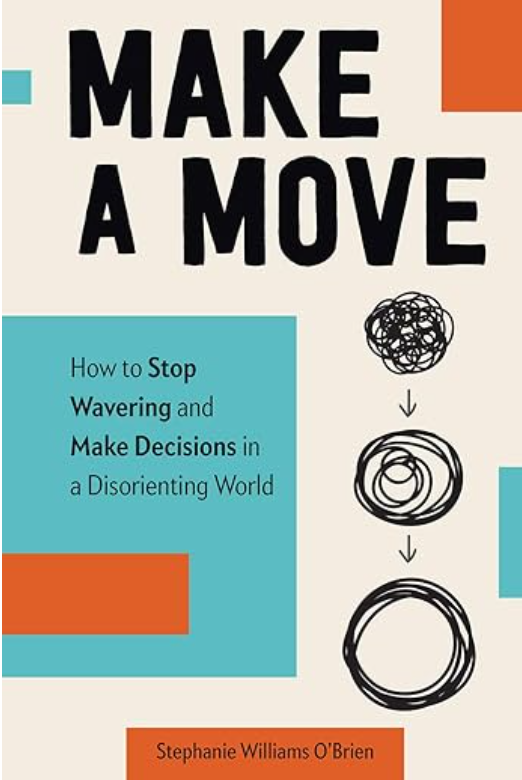
In this episode I interview Stephanie O’Brien, author of Make a Move: How to Stop Wavering and Make Decisions in a Disorienting World.

Stephanie is an activist, professor at Bethel Seminary, and the founding pastor at Mill City Church in Minneapolis, MN. She is the co-host of @leadstoriespodcast with @josaxton.

Our interview about her previous book Stay Curious: How Questions and Doubts Can Save Your Faith can be found here: An Interview with Stephanie O’Brien (2020).

The Post-Christian Podcast and Giveaways:

Our goal with The Post-Christian Podcast is to reframe, simplify, and focus on our mission to make disciples in a post Christian culture. We discuss reaching new people and raising up leaders while removing the barriers of churchianity.

Be sure to sign up for my email newsletter at www.ericbryant.org for a chance to win future book giveaways and assessments!

Subscribe, Rate, and Review The Post-Christian Podcast at Spotify, Apple Podcasts, YouTube.com/@ericbryant777, or wherever you listen to your podcasts.

Listen or Watch Here:

APPLE PODCASTS – An Interview with Stephanie O’Brien

The Post-Christian Podcast – David Bennett (Author of A War of Loves)

In this episode I interview David Bennett, the author of A War of Loves: The Unexpected Story of a Gay Activist Discovering Jesus.

David recently completed his doctorate (DPhil) in theology at Oxford University where he now works as a postdoctoral research fellow in the Theology and Religion Faculty. He specialises in the relationship between the Trinity, Christian ethics, patristics, queer theology, discipleship and contemporary Anglican theology, especially the role of desire in knowing God.

The Post-Christian Podcast and Giveaways:

Our goal with The Post-Christian Podcast is to reframe, simplify, and focus on our mission to make disciples in a post Christian culture. We discuss reaching new people and raising up leaders while removing the barriers of churchianity.

Be sure to sign up for my email newsletter at www.ericbryant.org for a chance to win future book giveaways and assessments!

Subscribe, Rate, and Review The Post-Christian Podcast at Spotify, Apple Podcasts, YouTube.com/@ericbryant777, or wherever you listen to your podcasts.

Listen or Watch Here:

APPLE PODCASTS – An Interview with David Bennett

The Post-Christian Podcast – Fruitful (Audiobook Giveaway)

As we kick off season 7, I share a message in which I shared insights from my book Fruitful: Becoming Who God Created You to Be at Mosaic South Pasadena.

Jesus revealed a new way of looking at life, a new way of organizing the future. God’s design for our lives is that we would be productive, generative, and creative.

Jesus described four types of soils representing four types of people. Some are like a path, some are like a shallow and rocky soil, some are like soil growing thorns, and some are like a soil that produces much fruit.

Jesus’ parable points out that we struggle to become who we were created to be when we have a hardened heart, a shallow faith, or are easily distracted. If we can avoid these pitfalls, we will be fruitful.

Four Characteristics To Become Fruitful:

  • Receptivity
  • Tenacity
  • Intentionality
  • Proactivity

For more, go to ⁠ericbryant.org/fruitful⁠.

The Post-Christian Podcast and Giveaways:

Our goal with The Post-Christian Podcast is to reframe, simplify, and focus on our mission to make disciples in a post Christian culture. We discuss reaching new people and raising up leaders while removing the barriers of churchianity.

Be sure to sign up for my email newsletter at www.ericbryant.org for a chance to win future book giveaways and assessments!

Email me at eric@ericbryant.org with “Fruitful Audiobook” as the Subject to receive a free copy of the audiobook to Fruitful!

Subscribe, Rate, and Review The Post-Christian Podcast at Spotify, Apple Podcasts, YouTube.com/@ericbryant777, or wherever you listen to your podcasts.

Listen or Watch Here:

APPLE PODCASTS – Fruitful at Mosaic South Pasadena