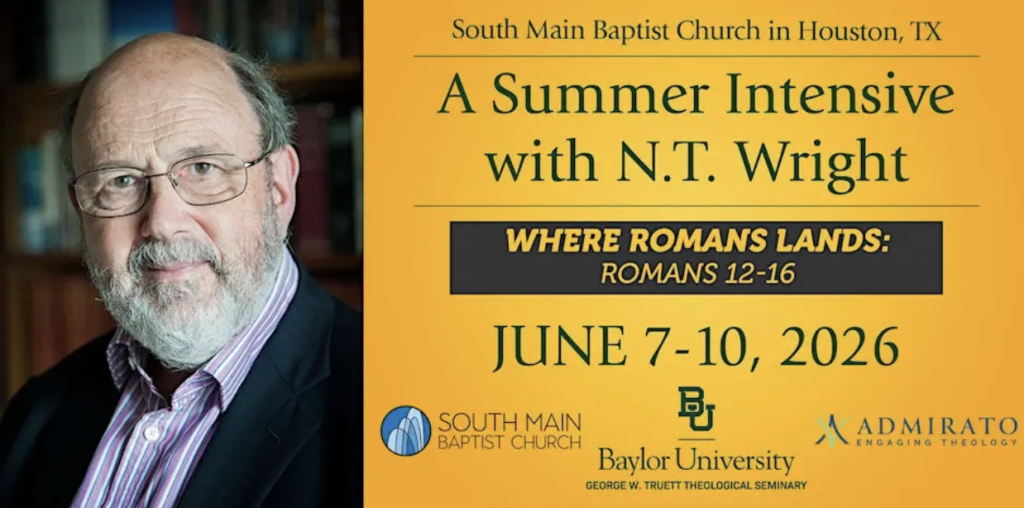
“Where Romans Lands” Summer Intensive with N.T. Wright was organized by Admirato.org.
We should expect that the outworking of Jesus’ death, resurrection, and ascension would be the same for His Church. There will be suffering, death, new life, and eventually a fully realized new creation.
Paul seems to have learned the truth behind the old Yiddish phrase: “If you want to make God laugh tell him your plans.”
A related corollary is: “If you want to make God said, tell Him you don’t have any plans.”
We need to dream adn imagine and seek to create a better future – even if we do not know all that lies ahead of us.
Paul was right about the resistance in Jerusalem but he overestimated what may be able to come to pass as we suspect he never made it to Spain.
Romans 15:14-33
Coming to Rome at last
14 When I think of you, my dear family, I myself am thoroughly convinced that you are full of goodness, filled with all knowledge, and well able to give one another instruction. 15 But I have written to you very boldly at some points, calling things to your mind through the grace which God has given me 16 to enable me to be a minister of Messiah Jesus for the nations, working in the priestly service of God’s good news, so that the offering of the nations may be acceptable, sanctified in the holy spirit.
17 This is the glad confidence I have in Messiah Jesus, and in God’s own presence. 18 Far be it from me, you see, to speak about anything except what the Messiah has accomplished through me for the obedience of the nations, in word and deed, 19 in the power of signs and wonders, in the power of God’s spirit. I have completed the announcement of the Messiah’s good news from Jerusalem round as far as Illyricum. 20 My driving ambition has been to announce the good news in places where the Messiah has not been named, so that I can avoid building on anyone else’s foundation. 21 Instead, as the Bible says,
People who hadn’t been told about him will see; people who hadn’t heard will understand.
22 That’s why I have faced so many obstacles to stop me coming to you. 23 But now, finding myself with no more room in these regions, I have a great longing to come to you now at last after so many years, 24 and so to make my way to Spain. You see, I’m hoping to see you as I pass through, and to be sent on my way there by you, once I have been refreshed by you for a while.
Aid for Jerusalem
25 Now, though, I am going to Jerusalem to render service to God’s people there. 26 Macedonia and Achaea, you see, have happily decided to enter into partnership with the poor believers in Jerusalem. 27 They were eager to do this, and indeed they owe them a debt. If the nations have shared in the Jews’ spiritual blessings, it is right and proper that they should minister to their earthly needs. 28 So when I have completed this, and tied up all the loose ends, I will come via you to Spain. 29 And I know that when I come to you I shall come with the full blessing of the Messiah.
30 I urge you, my dear family, through our Lord Jesus the Messiah and through the love of the spirit: fight the battle for me in your prayers to God on my behalf, 31 so that I may be rescued from the unbelievers in Judaea, and so that my service for Jerusalem may be welcomed gladly by God’s people. 32 If this happens, I will come to you in joy, through the will of God, and be refreshed by being with you. 33 May the God of peace be with you all. Amen.
Paul sees the Church filled with “God’s goodness and knowledge” because of what He’s seen God at work already!
This doesn’t mean that there won’t be more need for a renewed filling from time to time.
A Christian professor was once asked: “Are you filled with the Spirit?”
His response: “Yes, but I leak.”
God has given Paul grace to serve and announce to the entire world that the Jewish Messiah is now Lord of all peoples and nations!
All God’s people are called together to be God’s royal priesthood – “the priestly service of God’s good news.”
The offerings we make are not to appease an angry God like in the pagan world. In this case, “the offering of the nations” is actually the Gentiles themselves. The same language is used in Romans 12:1-2 where we are to offer our bodies as a “living sacrifice.” We should not be shy about using Temple language and sacrificial language when referring to our worship of the Lord.
In Romans 15:17-20, Paul celebrates God’s goodness to work through him rather than this being an arrogant brag. He is celebrating God’s cascading grace!
In 1 Samuel 7, we see the phrase: here I raise my “Ebenezer” which refers to a rock or pillar that reminds us of when God helped us in the past so we can trust Him now and into the future.
“I have completed the announcement of the Messiah’s good news from Jerusalem round as far as Illyricum. ” Paul had not communicated the message of Jesus to all people in those regions, but there was now a church in these nations. The seeds have been planted and there would be fruit in the years to come!
But what about North Africa or further East?
Perhaps Paul knew of other apostles who had traveled in those directions.
Paul knew his calling and lived it out. He was focused on the Gentiles of the Roman Empire and planted churches in the Middle East, Asia, and Europe!
It’s a beautiful thing to know your calling and focus on that rather than being distracted by other options.
Paul had never been to Rome before, so who planted the church in Rome?
Many think it was Peter (see Acts 12:17 – “then he left for another place”).
It could have been anyone though! The message of Jesus was spreading organically and supernaturally.
Paul is coming as an evangelist and wanting to share in spiritual blessings. There was room for Paul to advance the Gospel, but he is being respectful of those who are already serving there. Paul does have ambitious plans. He wants to go to Rome and then eventually on to Spain. He isn’t planning to stay in Rome and usurp anyone’s authority.
So why did Paul want to go to Spain?
The most natural landing spot if he had made it would have been the city of Tarraco where there was a giant temple to Augustus under construction. (That temple is now underneath the cathedral).
Some think Paul wanted to advance the Kingdom in order to hasten Jesus’ return.
More likely, Paul wanted to go to pronounce Jesus as Lord and King wherever people were proclaiming “Caesar is Lord.” He wanted Jesus-shaped communities to show up the Caesar-shaped communities.
Paul thought of himself as a missionary sent from Antioch. In fact, he tended to land back in Antioch before going out again even as he might stop in Jerusalem on his travels. At this point in his ministry, Paul was not planning on going East any longer (See his farewell to the Ephesians in Acts 20). Paul wanted to see Rome as his new sending church to go even further West.
Paul has been collecting funds from the Gentile churches in order to help the impoverished church in Jerusalem. The people of Jerusalem were suffering from a famine.
Paul is rather coy in his fundraising attempts. (He spent 2 Corinthians 8-9 trying to raise funds without ever mentioning the word “money.”) Remember Peter had asked Paul to remember the poor which he assured Peter he planned to do so (See Galatians 2:10).
The way Paul wants the Roman church to work through the conflict in Romans 14-15 seems to lead naturally to the idea that “If the nations have shared in the Jews’ spiritual blessings, it is right and proper that they should minister to their earthly needs.“
We discover in Acts that the very people Paul prayed and cried over in Romans 9:1-5 persecuted Paul back in Jerusalem. Paul had to remember his own advice given in Ephesians 6 – “our real battle is not against flesh and blood but against spiritual forces of darkness.” In Acts 22, Paul tells the story of the people of Israel leading up to his mission to communicate about the Messiah to the Gentiles. Rather than welcoming his story, the Judeans once again turned against him.
We do know that Paul made it to Rome from the book of Acts where he meets with the Judean leaders and proclaims the Messiah and His Kingdom to them. He got to worship the God of peace right under the nose of the Roman military.
God’s purposes will always be a surprise in the moment but in retrospect we can see more clearly why things went as they did.